
Ants are one of the most prevalent insects in the US and a common pest that frequently infests buildings such as residences, offices, and other structures.
They are social insects that coexist in huge groups and work together. Although they often move inside to hunt for food or shelter, they usually nest outside.
There are many types of ants, but today we’ll discuss the 2 most common ants – Argentine ants vs. Carpenter ants. Read on to learn more.
Overview: Argentine Ants
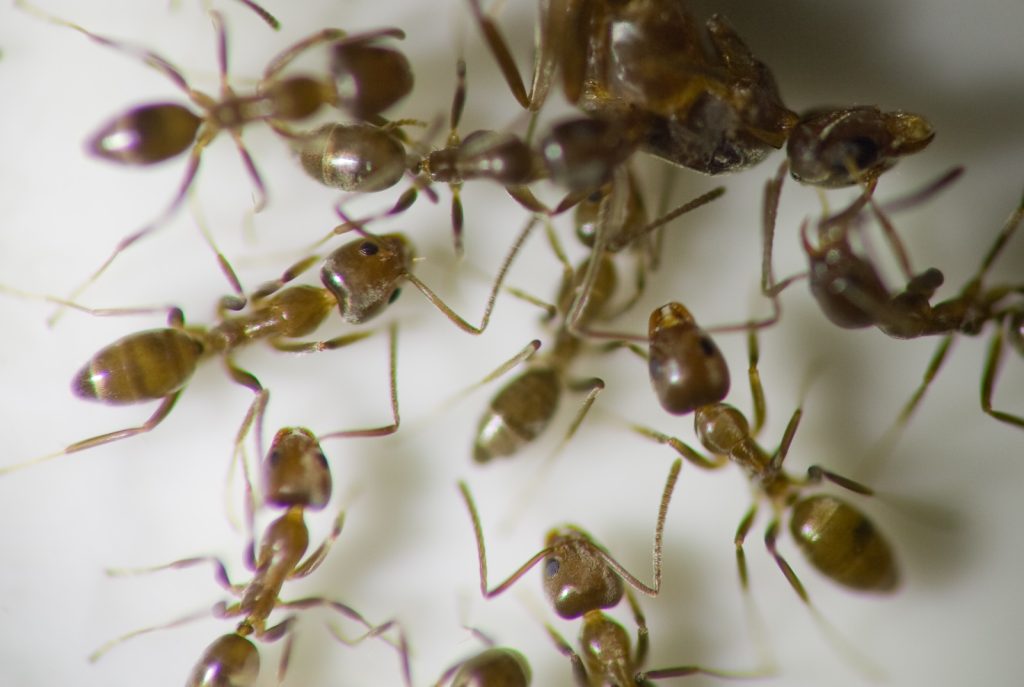
As its name suggests, the Argentine ant is a South American native discovered in Western Australia (WA) for the first time in 1941, first in Albany and then in Perth.
These invasive species were once only found in Argentina, Paraguay, Uruguay, Bolivia, and southern Brazil. They are currently widespread throughout the world.
Argentine ants are now common in Hawaii, California, and the southern states. Infestations of a lesser magnitude can also be found in Arizona, Missouri, Indiana, Illinois, Maryland, and the Pacific Northwest.
Overview: Carpenter Ants

Carpenter ants, one of the biggest ant species in the United States, are familiar visitors in many homes.
They are a type of ant that gets their name from the manner they create their nests, in which they dig wood and form smooth tunnels within it. They simply chew through wood to make nests; they don’t eat it.
Genus
Carpenter ants come in over 900 different species. They are members of the Formicidae family, including the genus Camponotus. There are 600 species of giant ants in the genus Camponotus, 43 of which are found in North America.
Carpenter ant colonies are eusocial and comprise workers, reproductive swarmers, and queens, among many other specialized castes. Each caste has a distinct appearance and a distinct purpose.
The Argentine ant, on the other hand, belongs to Linepithema humile and is a native of South America but is now widely scattered throughout the world and an invasive species in many places.
The Dolichoderinae subfamily of ants, or odorous ants, includes Argentine ants. The worker caste of these ants lacks a sting, has a transverse slit-like anal orifice, and has 1 constricted petiolar segment.
Physical Appearance
Argentine ants are typically between 2.2 and 2.8 mm long, and their color ranges from light to dark brown.
They have 12 segmented antennae and no wings. When crushed, they give out a musty smell. Queens are 4 to 6 mm longer than workers, which is a slight increase. Queens and males who reproduce sometimes have wings.
Since there are various types of carpenter ants in the United States, size and color are not always accurate identification factors.
The heart-shaped head, circle of hairs around the anus, and rounded profile of their thorax set carpenter ants apart from other species. These distinguishing features are best visible when magnified.
The workers are between 3/8 and 1/2 inches long and are either entirely black or red and black; however, one species is only 3/16 inches long.
Males and queens have wings and are more prominent than workers. These wings are either transparent or pale brown. Carpenter ants with wings might be seen in the spring or the fall.
Once they build a new nest, queens stop having wings.
See our detailed guide on How To Identify Carpenter Ants.
Habitat
Argentine ants are drawn to moist environments. Therefore, their presence inside a house or other building may indicate a moisture problem that needs to be resolved.
Outside, they typically make small, damp nests beneath vegetation, along walkways, or under stones or boards. They are known to enter buildings in significant numbers when the weather outdoors is unfavorable for the ants to thrive, either too cold or too dry.
Once inside, they will continue to build their nests close to sources of moisture such as plant pots, sinks, and pipes. Ants frequently enter homes by crawling along tree branches or powerlines that come into touch with the building.
Although some species nest in the earth, most carpenter ants build their nests in dead or rotting wood, including tree stumps, logs, and branches. They also make their nests out of wet building materials that can occur due to leaks in homes and sheds.
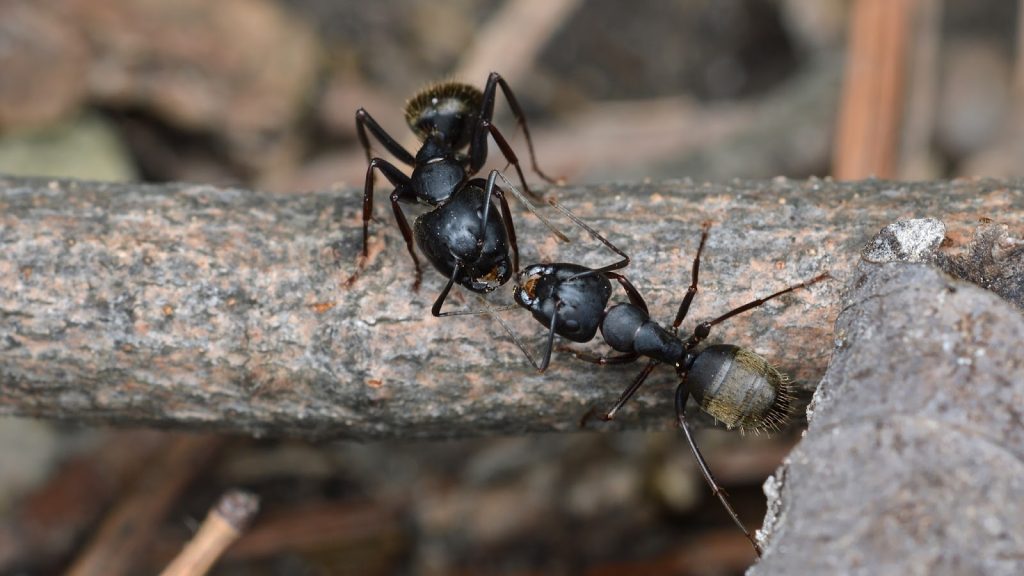
Colonies create satellite nests by excavating tunnels and galleries in damp wood.
Since they only contain worker ants, pupae, and mature larvae—not eggs, which require the wetness of the original nest—these satellite nests can exist in drier, firmer wood. They tidy up as they dig, putting the sawdust produced outside the nest.
Characteristic and Behavior
Argentine ants are very adaptive and can build their nests in many locations. Colonies can have hundreds of queens and are enormous. Commonly, argentine ants nest in damp soil adjacent to structures, along pavements, or boards.
They are aggressive and relentlessly attack other ants. They first murder the majority of them, then they consume their food. They harm the vegetation and fauna and drive away native ants.
Most carpenter ants forage at night since they are nocturnal, but some feed during the day. Foraging has been seen more frequently in spring and summer. See When Are Carpenter Ants Most Active?
Finding food for the colony requires foraging workers to go 100 yards from the nest. Omnivorous carpenter ants will search both inside and outside.
Carpenter ants are not regarded as aggressive species; they generally only bite when startled or threatened.
Lifecycle
Argentine ants undergo complete metamorphosis, the same developmental process as other ant species. The whitish eggs hatch into larvae after about 28 days and take roughly 74 days to reach adulthood.
One or a few queens usually lay all the eggs in carpenter ant colonies. The reproductive cycle starts when a newly married queen locates a new location to nest and lays numerous eggs.
Carpenter ants live an average of 7 to 10 years.
Summary
Argentine ants are smaller compared to carpenter ants in size. They have light and dark brown bodies, while carpenter ants have brown, red, or black bodies.
Carpenter ants are a big problem because they create their nests by digging through wood and can cause significant damage to homes. The size of the body is the primary distinction between argentine ants and carpenter ants.
Recommended Reading: