
Fire ants are undoubtedly troublesome insects that no one wants to get bitten or stung by—their venomous stings can cause severe pain and burning sensation to their unlucky victims and even develop life-threatening reactions in some cases.
As a result, you should immediately eliminate fire ants once you notice them nesting on your property. But before you can get rid of these little suckers, you must first know the difference between them and other less aggressive red ants that people tend to mistake for fire ants.
That said, read on to figure out how to tell the difference between fire ants and other less harmful red ants.
Fire Ants vs. Red Ants
It can be difficult to tell the difference between a fire ant and other ants since not all fire ants are red, and not all red ants are fire ants!
First, there are two types of fire ants in the United States: native and imported. The first time Imported fire ants were accidentally introduced to the US was in the 1930s. These invasive insects are often found in the humid Southeastern United States because they need a good food source and some moisture to survive. But they managed to spread north and west where there wasn’t much water. Warm climates, particularly those in the South, are ideal for fire ants.

Fire ants can be found in many places in the country, but you’ll typically find them in larger numbers in Alabama, Arizona, Arkansas, California, Florida, Georgia, Hawaii, Louisiana, Kansas, Kentucky, Mississippi, Missouri, Maryland, Nevada, New Mexico, North Carolina, Puerto Rico, Oklahoma, South Carolina, Texas, Tennessee, and Virginia.
On the other hand, native fire ants like to live in the dry southwest United States and northern Mexico. Native fire ant bites and stings are equally painful despite being less aggressive. Southern fire ants, small fire ants, tropical fire ants, and desert fire ants are some of the native species of fire ants.
Fire ants can be distinguished from other ants by differences in behavior. Because they are so aggressive, fire ants immediately swarm if someone disrupts their mounds. On the other hand, red ants usually don’t show aggressive reactions to such disruption.
One of the most straightforward ways to tell the difference between aggressive fire ants and red ants is through their color. Fire ants can be either red fire ants (RIFAs) or black fire ants (BIFAs). As a result, fire ants have either a red or black color that you should be able to notice once you see them. On the other hand, red ants typically have a light brown or reddish-brown color.
Finally, a key distinguishing feature of fire ant mounds is that they are typically found in moist areas and only appear after rain. They also don’t feature openings at the top like other anthills do.
Four Types of Red Ants that Look Like Fire Ants But Are NOT!
Velvet ants, acrobat ants, tawny crazy ants, and carpenter ants can all be mistaken for fire ants. Here’s how to tell the difference…
1. Velvet Ants vs. Fire Ants
It’s easy to mistake velvet ants for fire ants. Velvet ants are actually wasps, even though female velvet ants don’t have wings. They vary from fire ants by having straight antennae rather than elbowed ones and a slight constriction between the thorax and abdomen. They can occasionally wander into houses or be found in pastures or lawns.
The key differences between fire ants and velvet ants are listed below:
| Trait | Velvet Ants Ants | Fire Ants |
| Color | bright scarlet or orange but may also be silver, gold, black, or white. | Red or Black |
| Size | 6-20 mm millimeters long | 1.5-5 millimeters long |
| Body | Covered in fuzz | Not covered in fuzz |
| Nesting | Nest in open, dry, sandy, sunny areas like sunny lawns and cemeteries. | Nest in nearly any type of soil, although they prefer sunny and open areas like meadows, lawns, golf courses, pastures, parks, playgrounds, and other wilderness and agricultural areas |
| Aggressiveness | Not very aggressive and will escape when encountered | Extremely aggressive and are likely to attack humans |
Velvet ants can be found along the East Coast.
2. Acrobat Ants vs. Fire Ants
Many people mistake acrobat ants for fire ants due to their red and black body colors that look almost identical to those of red and black fire ants. Acrobat ants also nest in leaves and mulch, like fire ants. But unlike the oval-shaped abdomens of fire ants, acrobat ants feature heart-shaped abdomens.
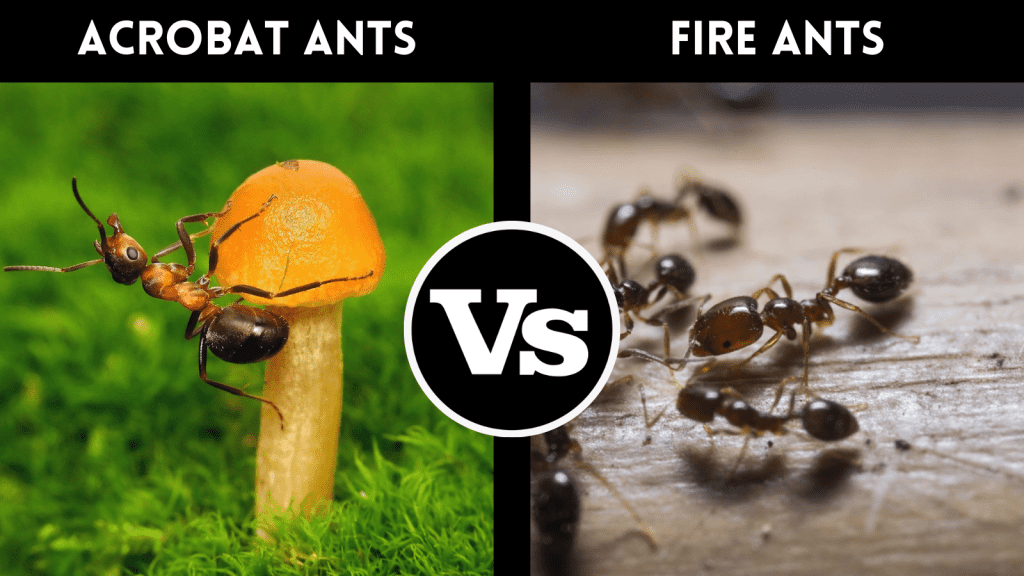
The key differences between fire ants and acrobat ants are listed below:
| Trait | Acrobat Ants | Fire Ants |
| Color | Light brown, red, or black | Red or Black |
| Size | 2.6-3.2 millimeters long | 1.5-5 millimeters long |
| Nesting | They nest in moist wood softened by decay or fungi and are typically found under rocks, or in logs, trees, and firewood. | Nest in nearly any type of soil, although they prefer sunny and open areas like meadows, lawns, golf courses, pastures, parks, playgrounds, and other wilderness and agricultural areas |
| Aggressiveness | Workers can show aggressive behavior | Extremely aggressive and are likely to attack humans |
Acrobat ants are typically found throughout North America.
3. Tawny Crazy Ants vs. Fire Ants
Tawny crazy ants (Rasberry crazy ants) can also be mistaken for fire ants due to their reddish-brown color, but both are fundamentally different. Nearly any object or space (including stumps, rocks, potted plants, soil, or concrete) can be home to Rasberry crazy ants.
Although worker ants will forage inside houses and other buildings, nests are often found outdoors. Nearly any damp object can serve as a nesting spot for tawny crazy ants—they like moisture just like fire ants do!
The key differences between fire ants and tawny crazy ants are listed below:
| Trait | Tawny Crazy Ants | Fire Ants |
| Color | reddish-brown | Red or Black |
| Size | 2.0–2.4 millimeters long | 1.5-5 millimeters long |
| Nesting | Nest in leaf debris, waste material, and damp soil. | Nest in nearly any type of soil, although they prefer sunny and open areas like meadows, lawns, golf courses, pastures, parks, playgrounds, and other wilderness and agricultural areas |
| Aggressiveness | Move randomly and can be aggressive | Extremely aggressive and are likely to attack humans |
Tawny crazy ants can be found in Alabama, Florida, Georgia, Louisiana, Mississippi, and Texas.
4. Carpenter Ants vs. Fire Ants
Carpenter ants are another type of ant you can easily mistake for fire ants due to their reddish-brown body color. Florida carpenter ants and Camponotus sayi are the most common types of red and black carpenter ants in the United States.

The key differences between fire ants and carpenter ants are listed below:
| Trait | Carpenter Ants | Fire Ants |
| Color | Reddish-brown | Red or Black |
| Size | 9.5-13 millimeters long | 1.5-5 millimeters long |
| Nesting | Nest in wooden structures and trees | Nest in nearly any type of soil, although they prefer sunny and open areas like meadows, lawns, golf courses, pastures, parks, playgrounds, and other wilderness and agricultural areas |
| Aggressiveness | Not very aggressive | Extremely aggressive and are likely to attack humans |
| Activity | At night | In the late afternoon and morning |
Carpenter ants are typically found in Alabama, Arizona, Colorado, California, Florida, Georgia, Louisiana, Kansas, Mississippi, Nebraska, New Mexico, Nevada, Oregon, South Carolina, Texas, and Utah.
Final Thoughts
This is everything you need to know to tell the difference between fire ants we all hate and other more tolerable types of ants. Hopefully, this will help you identify fire ants and take steps to get rid of them and keep your family safe.
Recommended Reading: